Train harder.
Move smarter.
Last longer.
Specialized Pilates programming for competitive athletes and serious movers — improving power transfer, kinetic chain efficiency, and injury resilience across every sport.
Elevate Your Performance →
The performance edge most athletes aren't using.
Elite athletes in every discipline — triathlon, golf, tennis, swimming, basketball, dance, martial arts — have discovered that Pilates is not a rehabilitation tool or a flexibility class. In the hands of a certified Athletic Conditioning Specialist, Pilates is a precision performance system that targets the biomechanical foundations every sport demands: core stability, scapular control, hip dissociation, single-leg power, rotational efficiency, and full kinetic chain integration.
At D2M, athletic conditioning sessions are built around your sport's specific demands. We analyze the movement patterns, joint stress patterns, and energy system requirements of your sport — then build a Pilates program that directly addresses the gaps between where your body is and what your sport requires of it.
The result is not just a stronger core. It is better sprint mechanics, more efficient stroke technique, greater rotational power, faster recovery between efforts, and a body that can sustain high performance output over a full season — and a career.
Built for every competitive discipline
Swimmers & Triathletes
Shoulder stability, rotational power, hip flexor mobility, and breathing efficiency
Runners
Hip extension mechanics, glute activation, lumbo-pelvic stability, and IT band management
Golfers
Rotational range, thoracic mobility, lateral stability, and asymmetrical strength correction
Tennis Players
Shoulder complex loading, serve mechanics, court movement efficiency, and deceleration control
Cyclists
Hip flexor length, thoracic extension, scapular stability, and knee tracking under load
Basketball Players
Vertical power, lateral quickness, single-leg landing mechanics, and ankle resilience
Football Players
Hip drive, rotational core power, deceleration control, and structural durability
Soccer Players
Deceleration mechanics, kicking power, ACL protection, and 90-minute structural endurance
Hockey Players
Hip flexor mobility, skating stride power, groin resilience, and shot rotation mechanics
Baseball Players
Hip-shoulder separation, thoracic rotation, arm deceleration, and rotational asymmetry correction
Pickleball Players
Shoulder stability, lateral quickness, ankle and Achilles resilience, and deceleration control
Dancers & Performers
Articulation precision, eccentric control, joint stability in extreme ranges, and performance longevity
What athletic Pilates actually does for your performance
Kinetic chain integration
Force production in sport doesn't come from isolated muscles — it travels through kinetic chains. Pilates trains the sequential activation and energy transfer that makes your body an efficient power system rather than a collection of working parts.
Injury prevention and resilience
Most sports injuries don't happen because of bad luck. They happen because of movement asymmetries, overloaded compensation patterns, and insufficient eccentric strength. Athletic Pilates corrects these before they become injuries.
Core stability — the real version
Pilates core training is not crunches or planks. It is coordinated activation of the deep stabilizer system — transverse abdominis, multifidus, pelvic floor, diaphragm — that provides the proximal stability every high-velocity distal movement requires.
Mobility with control
Passive flexibility without neuromuscular control is a liability in sport. Pilates builds active, controlled range of motion — so your hips, shoulders, and thoracic spine can move freely through the ranges your sport demands, under load and at speed.
Bilateral symmetry and imbalance correction
Every sport creates asymmetry. Pilates programming identifies and addresses your dominant-side compensations, leg length discrepancies, and rotational biases — reducing injury risk and improving movement efficiency on both sides.
Recovery and longevity
Athletic careers are limited by accumulated damage. Pilates reduces the neuromuscular and fascial stress that training accumulates, supports tissue recovery, and builds the structural resilience that keeps athletes competing at any age.
Deep dives for your sport
Every sport has specific movement demands, common injury patterns, and Pilates interventions that directly address them. Explore the dedicated programming page for your discipline.
Pilates for Runners
Hip abductor strength, glute activation, lumbo-pelvic stability, and the gait mechanics that separate injury-prone runners from durable ones.
Explore running programming → GolfPilates for Golfers
Thoracic rotation, hip dissociation, lateral stability, and the rotational core power that translates directly to club head speed and swing consistency.
Explore golf programming → CyclingPilates for Cyclists
Hip flexor mobility, thoracic extension, posterior chain activation, and the knee tracking corrections that cycling posture progressively destroys.
Explore cycling programming → TennisPilates for Tennis Players
Serve mechanics, shoulder complex stability, deceleration control, and the bilateral asymmetry correction that tennis seasons systematically create.
Explore tennis programming → Swimming & TriathlonPilates for Swimmers & Triathletes
Shoulder stability, rotational stroke efficiency, breathing mechanics, and hip flexor mobility that determines run performance off the bike.
Explore swim & triathlon programming → PickleballPilates for Pickleball Players
Shoulder stability, lateral quickness, Achilles resilience, and the deceleration control that prevents pickleball's most common and costly injuries.
Explore pickleball programming → FootballPilates for Football Players
Hip drive and ground force, rotational core power, deceleration mechanics, and the structural durability that keeps players on the field through a full season.
Explore football programming → BasketballPilates for Basketball Players
Vertical power, lateral quickness, single-leg landing mechanics, and the ankle and knee resilience that an 82-game season demands.
Explore basketball programming → HockeyPilates for Hockey Players
Hip flexor mobility, skating stride power, adductor and groin resilience, and the shot rotation mechanics that Pilates uniquely addresses.
Explore hockey programming → SoccerPilates for Soccer Players
ACL protection through deceleration mechanics, kicking power from the kinetic chain, and the structural endurance to maintain quality across 90 minutes.
Explore soccer programming → BaseballPilates for Baseball Players
Hip-shoulder separation, thoracic rotation, scapular timing, and the arm deceleration mechanics that protect pitchers and position players across 162 games.
Explore baseball programming → Dance & PerformancePilates for Dancers & Performers
Articulation precision, eccentric strength, controlled range of motion, and the career longevity that clinical Pilates uniquely provides performers.
Explore dance programming →How D2M athletic conditioning is structured
Sport-specific movement analysis
Before a single exercise is assigned, we analyze your sport's biomechanical demands and identify where your current movement patterns create performance limitations or injury risk. This informs every programming decision.
Foundation stabilization
We build the deep stabilizer system — the lumbopelvic complex, scapular stabilizers, and joint centration mechanics — that every sport relies on. Without this foundation, speed and power training simply amplifies existing dysfunction.
Sport-specific strength and power
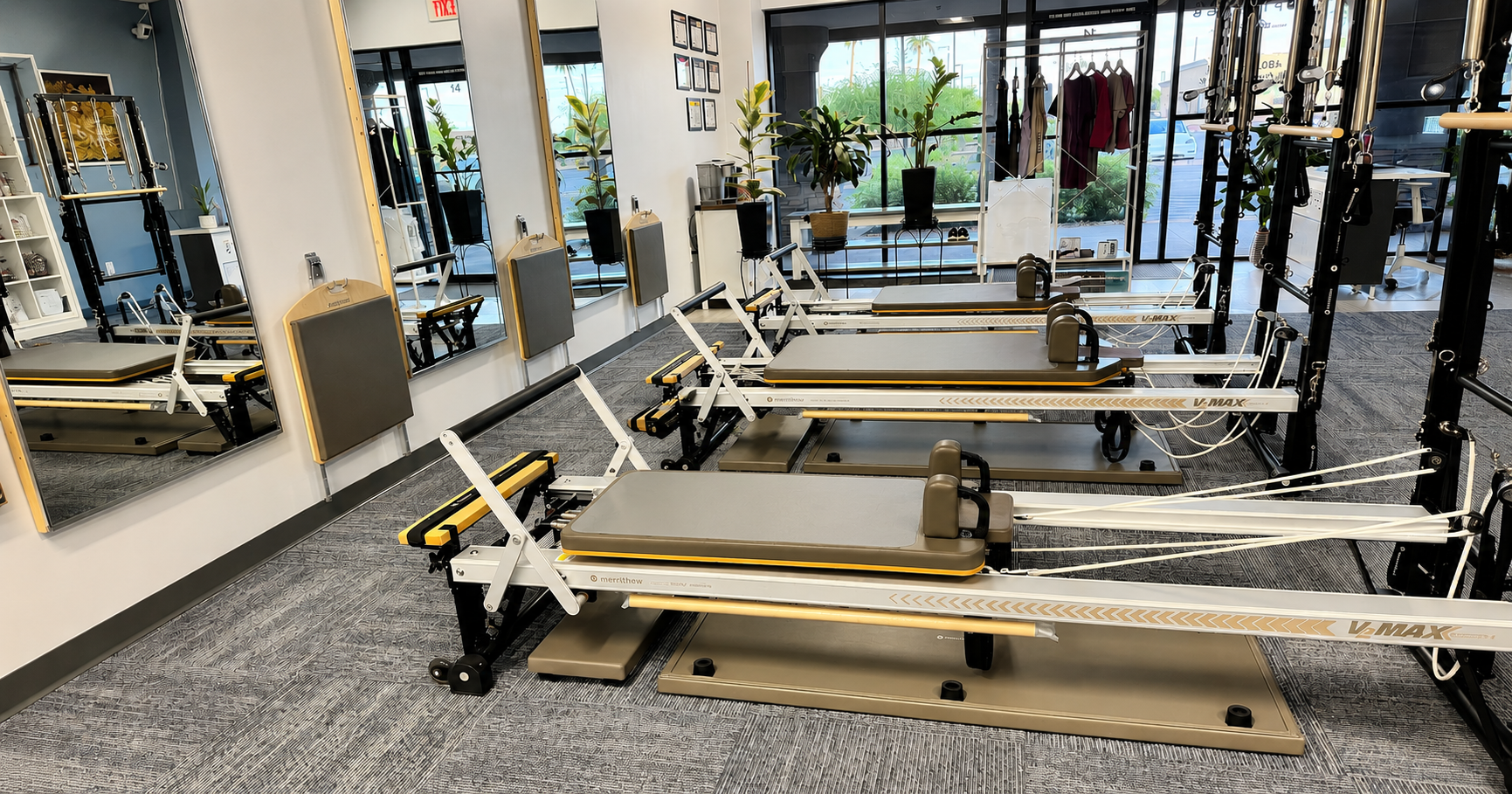
Once the foundation is solid, we build sport-specific strength patterns — rotational power, eccentric deceleration, single-leg loading, overhead stability — using the full STOTT apparatus suite to create precise training environments.
Performance integration and maintenance
We integrate your Pilates work with your full training program — periodizing around your competitive season, managing load during high-volume training blocks, and building the maintenance protocols that sustain performance year-round.
Athletic conditioning FAQ
How does Pilates actually improve athletic performance?
Pilates improves the quality of foundational movement patterns that all sport is built on — core stabilization, kinetic chain sequencing, joint centration, breathing mechanics, and eccentric control. By improving these fundamentals, sport-specific training becomes more efficient, force production increases, and injury risk decreases.
Will Pilates interfere with my regular training program?
No — the best athletic conditioning programs are designed to complement your existing training, not compete with it. We periodize D2M sessions around your training schedule, competition calendar, and recovery demands. Many athletes use Pilates as an active recovery modality as well as a performance development tool.
I am already very fit. Will Pilates challenge me?
Yes — and this surprises almost every athlete who walks through the door. Cardiovascular fitness and muscular strength do not guarantee the deep stabilizer activation, joint control under load, and kinetic chain efficiency that Pilates demands. Most highly trained athletes discover significant gaps in their foundation within the first session.
Can Pilates help me recover from a sports injury?
Yes — Devi's Post-Rehabilitation Specialization means D2M can program for both injury recovery and performance enhancement. For athletes recovering from injury, we design programs that restore full function while maintaining the conditioning gains your training has built.
How often should athletes do Pilates?
Most athletes benefit from 1–2 sessions per week during the off-season for conditioning, and 1 session per week in-season for maintenance and injury prevention. Sessions are always periodized around your training calendar and competition schedule.
Do you work with youth athletes?
Yes. Youth athletes benefit enormously from early investment in movement quality — developing the body awareness, bilateral balance, and foundational stability that supports their development through high school, college, and beyond. The earlier the foundation is built, the greater the long-term return.
Your sport demands more than strength. Let's build the rest.
Reserve your first athletic conditioning session — including a full movement and sport-specific assessment — and discover what your body has been holding back.