Hip pain
is a mechanics
problem.
Clinical Pilates programming for hip impingement, labral tears, hip bursitis, hip flexor strain, and hip osteoarthritis — addressing the movement pattern dysfunctions that cause hip pain and restoring full, pain-free function.
Book a Session →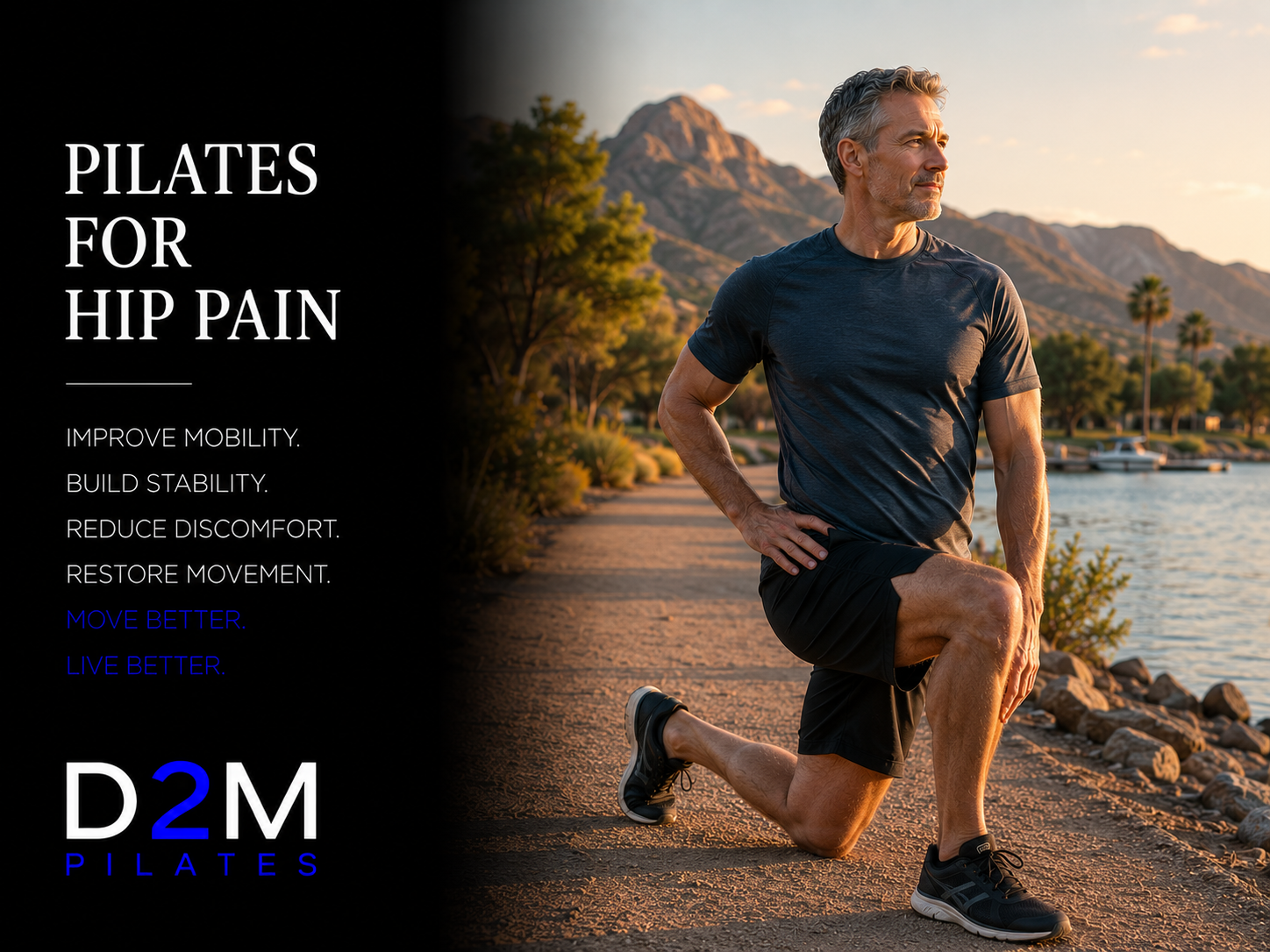
The hip is the body's power center.
When it fails, everything compensates.
The hip joint is the body's largest and most powerful joint — responsible for generating the locomotion, stabilization, and force transfer that every athletic and daily movement depends on. When the hip fails, the lumbar spine, knee, and ankle all compensate — creating a cascade of secondary pain conditions.
Hip pain conditions — impingement, labral tears, bursitis, hip flexor strains, and osteoarthritis — all share a common thread: a breakdown in the movement mechanics and muscular control that protect the hip joint from excessive loading. Pilates addresses these mechanics directly.
At D2M, hip pain clients receive a comprehensive movement assessment that identifies the specific mechanical contributors to their pain. Programming is then built to restore deep hip stability, correct movement pattern dysfunction, and progressively reload the hip joint.
Hip conditions D2M programs for
Femoroacetabular Impingement
Movement pattern correction and hip strengthening that reduces the impingement contact mechanics — building the deep stabilizer control that keeps the femoral head centered in the acetabulum.
Hip Labral Tear
Deep hip stabilizer reactivation, movement pattern correction, and progressive hip loading that restores labral function — whether managed conservatively or as post-surgical rehabilitation.
Greater Trochanteric Bursitis
Hip abductor strengthening and iliotibial band loading management that addresses the biomechanical root cause of greater trochanteric bursitis rather than just managing the inflammatory symptom.
Hip Flexor Strain
Progressive hip flexor loading, movement pattern correction, and kinetic chain integration that restores full hip flexor function and prevents the recurring strains that inadequate rehabilitation causes.
Hip Osteoarthritis
Low-impact hip strengthening, joint lubrication through movement, and gait mechanics improvement that reduces hip OA pain and maintains the functional capacity arthritis can progressively erode.
Post-Hip Surgery Recovery
Staged return-to-function after hip arthroscopy, labral repair, or total hip replacement — respecting all surgical precautions while systematically restoring full strength, stability, and movement quality.
How Pilates resolves hip pain
Deep hip stabilizer activation
The deep hip rotators are the primary stabilizers of the femoral head in the acetabulum. Their inhibition is central to virtually every hip pain condition. Pilates systematically reactivates them.
Hip abductor strengthening
Weak hip abductors drive the majority of hip pain conditions — from bursitis to labral tears to impingement. Pilates progressive hip abductor loading is one of the most evidence-supported interventions for hip pain.
Movement pattern correction
The movement dysfunctions that cause hip pain — femoral adduction in stance, anterior pelvic tilt, hip flexor dominance — are the patterns Pilates most directly addresses.
Kinetic chain integration
Hip pain almost always has contributions from the lumbar spine, knee, and ankle. Pilates addresses the full kinetic chain — not just the hip in isolation — producing more complete and durable relief.
Gait mechanics improvement
Altered gait mechanics both cause and perpetuate hip pain. Pilates systematically corrects the step length asymmetries, weight acceptance patterns, and hip extension limitations that drive gait-related hip loading.
Return to full activity
The goal of hip pain programming at D2M is not pain management — it is full return to the activities that matter to you. Every program is built around your specific functional goals.
Hip pain Pilates FAQ
Can Pilates help femoroacetabular impingement (FAI)?
Yes. FAI responds well to deep hip stabilizer activation, movement pattern correction, and progressive hip loading that reduces the impingement contact mechanics. Conservative management of FAI through clinical Pilates has excellent outcomes for many clients.
Is Pilates appropriate after hip labral repair?
Yes. Post-labral repair Pilates is one of D2M's core specializations. Programming is staged to respect surgical healing timelines while systematically restoring the deep hip stability, movement quality, and progressive loading that full recovery requires.
Can Pilates help greater trochanteric bursitis?
Yes. Greater trochanteric bursitis is almost always driven by hip abductor weakness and IT band loading — both of which Pilates addresses directly. Most bursitis clients experience significant improvement with consistent targeted hip strengthening.
Can Pilates help hip pain without surgery?
Yes — for many hip conditions, clinical Pilates is the most effective conservative management available. D2M programs address the biomechanical root causes of hip pain rather than just managing symptoms — often avoiding surgical intervention altogether.
Can Pilates help chronic hip pain?
Yes. Chronic hip pain responds well to clinical Pilates. The deep stabilizer inhibition, movement compensation patterns, and kinetic chain dysfunctions that perpetuate chronic hip pain are exactly what post-rehabilitation Pilates programming is designed to address.
Your hip pain has a movement cause. Let's find it.
Book a session at D2M and begin with a full hip movement assessment. We will build a program that addresses the root cause of your pain and restores full function.