Restored.
Stronger than before.
Clinical Pilates programming designed specifically for hip, knee, and shoulder replacement recovery — restoring full strength, confidence, and movement quality beyond what physical therapy alone can achieve.
Book a Session →
Cleared for activity is not the same as fully recovered.
Joint replacement surgery is a life-changing procedure. Physical therapy restores basic function and gets you walking, climbing stairs, and managing daily activities. But PT discharge is not the finish line — it is the starting point for the deeper work of restoring full neuromuscular capacity, movement quality, and kinesthetic confidence.
The period between PT discharge and full functional recovery is where most joint replacement patients plateau. Compensatory movement patterns persist. The replaced joint is not loaded with confidence. Surrounding musculature remains inhibited. Gait mechanics stay asymmetrical.
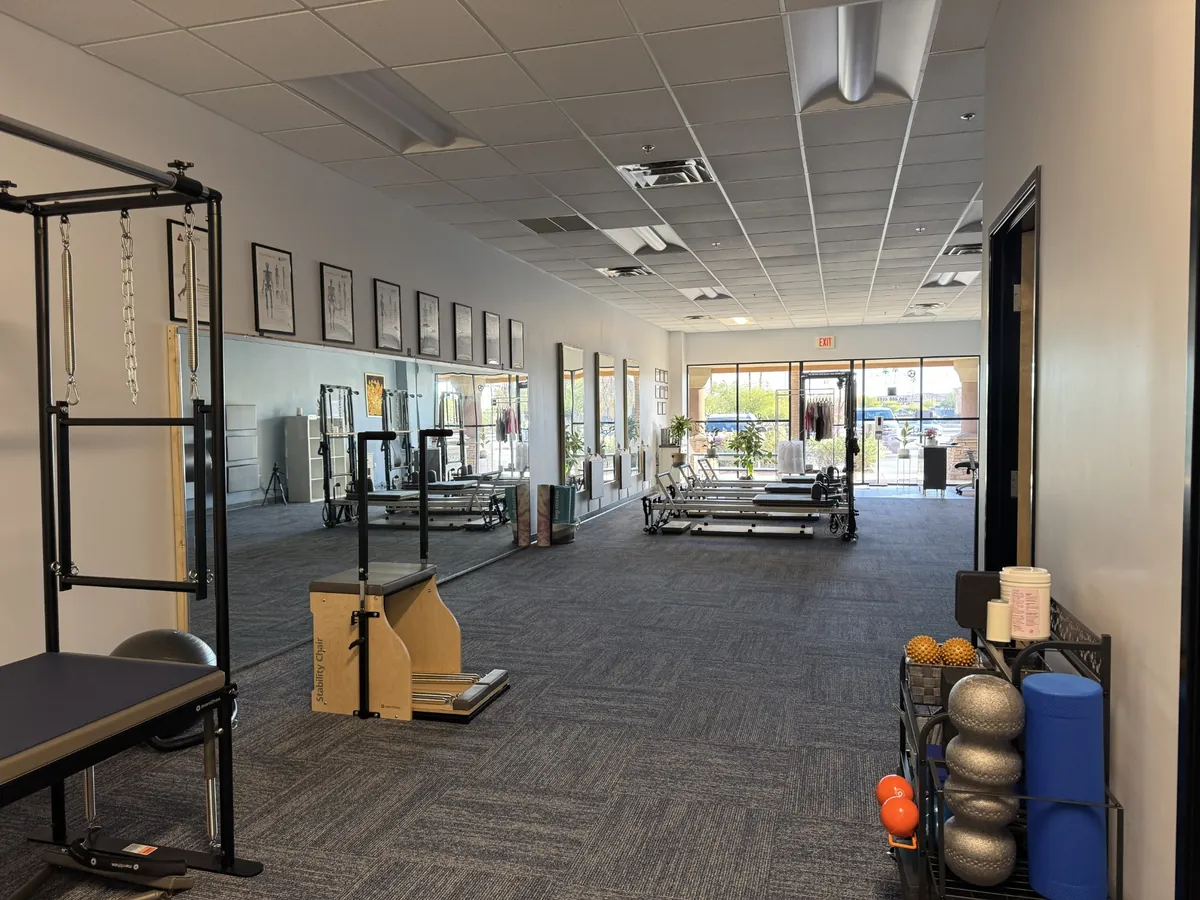
Using the full STOTT PILATES® apparatus suite, Devi programs staged, evidence-based progressions that systematically restore the neuromuscular control, strength, and movement quality your replaced joint needs to serve you for decades.
Programming for every joint replacement
Total Hip Replacement
Hip abductor strengthening, gait re-education, single-leg stability, and progressive return to full range of motion within surgical precautions specific to your approach.
Total Knee Replacement
Quadriceps reactivation, VMO targeting, terminal knee extension, step training, and progressive loading to restore confidence in the replaced knee.
Shoulder Replacement
Rotator cuff coordination, scapular stabilization, progressive overhead loading, and restoration of full glenohumeral rhythm for daily activities and sport.
Bilateral Replacements
Staged programming for clients who have had replacements on both sides — addressing the asymmetries, compensations, and sequencing demands unique to bilateral rehabilitation.
Revision Surgery Recovery
Conservative, individualized programming that respects revised hardware and healing timelines — always coordinated with your surgeon.
Long-term Joint Health
Ongoing programming that protects your replaced joint, distributes load efficiently, and reduces the risk of accelerated wear across years.
What post-replacement Pilates delivers
Restored proprioception
Joint replacement removes native mechanoreceptors. Pilates systematically rebuilds proprioceptive awareness through controlled, multi-plane loading that re-educates the nervous system.
Symmetrical gait mechanics
Most joint replacement patients develop asymmetrical gait patterns that persist for years post-surgery. Pilates corrects step length, weight acceptance, and push-off mechanics on both sides.
Full muscular restoration
Surgical atrophy and post-op inhibition leave surrounding musculature significantly weaker. Targeted Pilates restores full strength systematically and safely.
Kinetic chain integration
A replaced joint must function within a full kinetic chain. Pilates trains hip-spine rhythm, knee-ankle coordination, and shoulder-thoracic integration that isolated PT exercises miss.
Movement confidence
Fear of re-injury or implant failure is common after joint replacement. Progressive loading in a controlled environment builds the movement confidence daily life demands.
Implant longevity
Proper movement mechanics reduce the wear forces on replacement hardware — protecting your implant investment and supporting active living for decades.
Joint replacement Pilates FAQ
How soon after joint replacement can I start Pilates?
Most hip and knee replacement clients begin at 6–12 weeks post-surgery with physician clearance. D2M coordinates with your surgical team and respects all precautions specific to your implant and approach.
Is Pilates safe with a hip replacement?
Yes — with an instructor who understands the specific precautions. Devi's Post-Rehabilitation Specialist training includes hip replacement precaution protocols for posterior, anterior, and lateral approaches.
Can Pilates replace physical therapy after joint replacement?
No — they are complementary. PT addresses acute recovery and basic function. Post-rehabilitation Pilates picks up where PT ends, restoring full strength, movement quality, and kinetic chain integration.
What if I had my replacement years ago but still feel weak or uneven?
This is very common. Post-rehabilitation Pilates is effective at any point post-surgery — not just in the immediate recovery window.
Can I do Pilates if I have had both hips or both knees replaced?
Yes. Bilateral replacement programming is something D2M specifically designs for — addressing the unique sequencing, asymmetry, and load management demands that bilateral replacements create.
Your replacement deserves the recovery it was designed for.
Book a session at D2M and start with a full movement assessment. We will build a program around your specific joint, surgical approach, and recovery stage.