Scoliosis is
three-dimensional.
So is the solution.
Asymmetric Pilates programming for structural and functional scoliosis — addressing the rotation, lateral deviation, and sagittal changes of spinal curves with individualized precision.
Book a Session →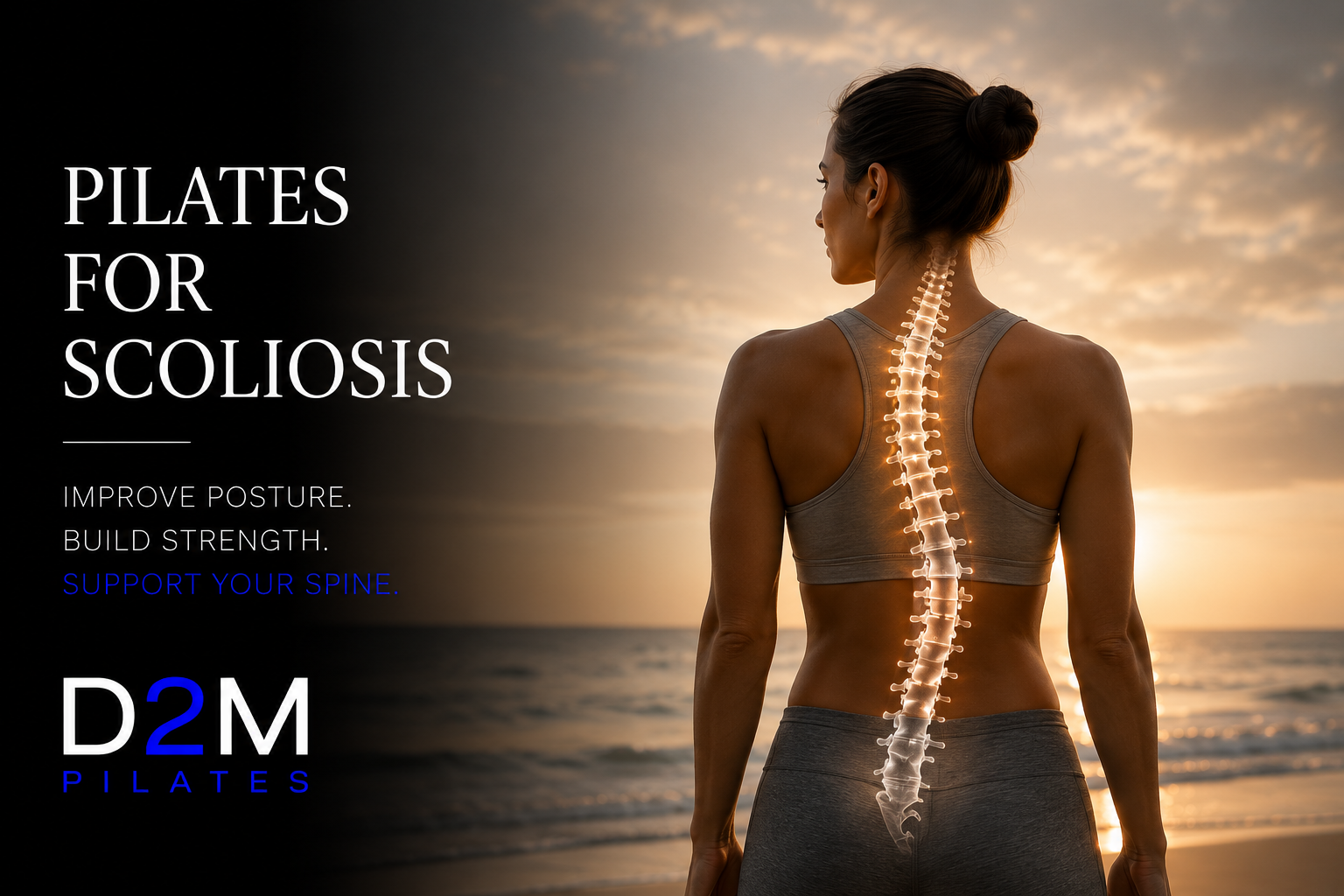
Scoliosis is not just a curve.
It is a three-dimensional deformity.
Most people think of scoliosis as a sideways curve in the spine. In reality, it is a three-dimensional deformity — involving lateral deviation, vertebral rotation, and changes to the sagittal curves simultaneously. Generic exercise programs that address only the side-to-side curvature miss two-thirds of the problem.
Effective Pilates programming for scoliosis must be asymmetric — designed differently for the concave and convex sides of each curve — and must address all three planes of the deformity. It must also be built around the individual's specific curve pattern, not a scoliosis template.
At D2M, scoliosis clients receive a comprehensive postural assessment that maps their specific curve, rotation, and compensation pattern. Every exercise is selected and cued individually to lengthen the concave side, strengthen the convex side, and address the rotational component that standard programs ignore.
D2M programs for every curve pattern
Adolescent Idiopathic Scoliosis
Progressive asymmetric programming to manage curve progression, reduce compensatory pain, and build structural support that preserves quality of life throughout adulthood.
Adult Degenerative Scoliosis
De novo scoliosis from asymmetric disc degeneration — addressed with stabilization, decompression, and targeted strengthening to manage pain and progression.
Functional Scoliosis
Apparent curves caused by leg length discrepancy, pelvic obliquity, or muscular imbalance — often fully correctable with appropriate asymmetric movement programming.
Post-Fusion Scoliosis
Progressive return-to-function after spinal fusion for scoliosis — respecting fusion levels while rebuilding mobility and strength above and below the instrumented segments.
Double Curve Patterns
S-curve and double major curve patterns require careful attention to the interaction between curves. D2M programs address both curves without overcorrecting either.
Thoracic Kyphoscoliosis
Combined lateral deviation and excessive thoracic kyphosis — addressed with thoracic extension work, rib cage mobilization, and rotational correction in all three planes.
What scoliosis Pilates achieves
Three-dimensional correction
D2M programming addresses lateral deviation, vertebral rotation, and sagittal curve changes — not just the side-to-side view that standard scoliosis exercise misses.
Pain reduction
The muscular imbalances, compressed facet joints, and fascial tension created by scoliotic curves produce significant pain. Targeted Pilates reduces these pain drivers systematically.
Curve management
Consistent asymmetric programming has been shown to slow progression and improve Cobb angle in some populations — always built around the individual's specific pattern.
Postural awareness
Scoliosis clients develop habitual postural patterns that reinforce their curves. Pilates builds the body awareness to recognize and correct these patterns in daily life.
Breathing improvement
Thoracic scoliosis restricts rib cage expansion and reduces breathing capacity. Pilates breathing techniques and rib cage mobilization restore respiratory function.
Confidence and quality of life
Progressive Pilates builds strength, reduces pain, and restores the physical confidence to live fully — regardless of curve magnitude.
Scoliosis Pilates FAQ
Can Pilates fix scoliosis?
Structural scoliosis cannot be reversed with exercise alone. However, consistent asymmetric Pilates programming can reduce associated pain, improve posture, slow curve progression, and significantly improve quality of life.
Is Pilates safe for scoliosis?
Yes — with an appropriately trained instructor. Generic Pilates is not designed for scoliosis and can reinforce existing asymmetries. D2M programs are built specifically around each client's individual curve pattern.
What degree of scoliosis can Pilates help?
Pilates is appropriate for mild to moderate curves (under 40–45 degrees Cobb angle) and for post-surgical curves of any magnitude. Larger curves should be coordinated with a spine specialist.
Can Pilates help if I had scoliosis surgery years ago?
Yes. Post-fusion scoliosis clients benefit significantly from Pilates programming that restores mobility and strength above and below the fused segments — reducing the compensatory loading that leads to adjacent segment problems over time.
Do I need to share my imaging before starting?
We strongly recommend sharing your most recent imaging before your first session so programming can be built around your actual curve measurements rather than visual assessment alone.
Your curve is unique. Your program should be too.
Book a session at D2M and begin with a comprehensive postural assessment. We will build an asymmetric program designed specifically for your curve pattern.