More power.
More consistency.
Less pain.
Pilates programming built for the demands of golf — rotational power, thoracic mobility, hip dissociation, and the asymmetric strength that produces a powerful, repeatable, injury-free swing.
Book a Session →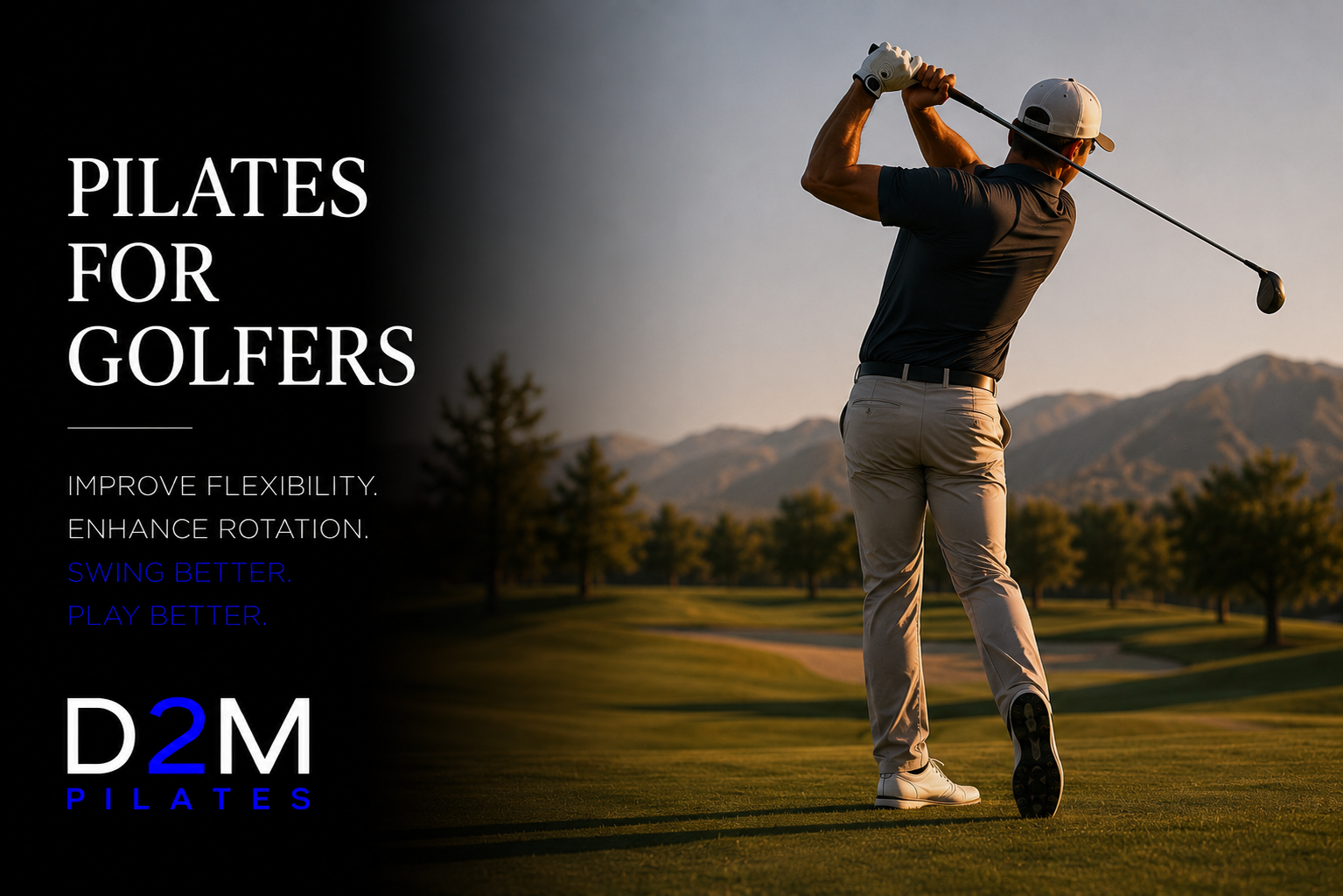
Golf is a rotation sport built on a foundation most players never develop.
The golf swing is one of the most complex athletic movements in sport — a full-body rotation generating significant ground reaction force, transferred through the kinetic chain in a precise sequence, producing club head speed through a pattern that is repeated hundreds of times per round and thousands of times per season.
The movement deficits that limit golf performance — restricted thoracic rotation, limited hip internal rotation, weak lateral stabilizers, asymmetric strength from years of swinging in one direction — are exactly the deficits that Pilates addresses most directly.
At D2M, golfer programming begins with a swing-informed movement assessment that identifies the mobility restrictions and stability deficits affecting your swing. Your program is built specifically around your pattern — maximizing rotation, building proximal stability, and correcting the asymmetries that produce consistency loss and injury.
The golf deficits Pilates corrects
Thoracic Rotation
Restricted thoracic rotation is the single most common mobility limitation in golfers. Pilates thoracic mobilization dramatically increases available rotation — immediately improving swing arc and power.
Hip Internal Rotation
Lead hip internal rotation restriction is a major contributor to swing faults and low back pain in golfers. Pilates systematically restores hip mobility with the specificity golf demands.
Lateral Stability
The lateral hip and glute complex must resist pelvic drop during the single-leg loading phases of the swing. Pilates builds this lateral stability with precision.
Swing Asymmetry Correction
Years of swinging in one direction create significant strength and mobility asymmetries. Pilates identifies and corrects these — improving consistency and reducing injury risk.
Rotational Core Power
True rotational power comes from the deep stabilizer system, not just the obliques. Pilates builds the proximal stability that allows maximum distal force transfer through the club.
Low Back Protection
Golf-related low back pain is epidemic. Pilates addresses the hip mobility restrictions, movement compensations, and stabilizer deficits that load the lumbar spine during the swing.
What golf Pilates delivers
More club head speed
When the kinetic chain is moving efficiently — thoracic spine rotating fully, hips loading and unloading correctly, core stabilizing proximally — club head speed increases without additional effort.
Greater consistency
Asymmetries and compensation patterns produce swing variability. Eliminating them through Pilates creates a more repeatable, consistent pattern round after round.
Reduced back pain
The majority of golf-related back pain is caused by addressable movement deficits. Pilates systematically corrects these — allowing pain-free play and practice.
Better posture at address
Pilates improves thoracic extension, hip hinge mechanics, and overall postural awareness — directly improving your setup position and alignment.
Longevity in the game
Golfers who address their movement deficits through Pilates play better, play longer, and play without the accumulated pain that ends many playing careers prematurely.
Post-round recovery
The fascial release and parasympathetic activation of Pilates sessions reduces the post-round tightness and soreness that affects next-day practice and play quality.
Golf Pilates FAQ
Will Pilates help my golf swing?
Yes — directly. The movement deficits that limit golf performance are the movement deficits Pilates addresses most specifically: thoracic rotation, hip mobility, lateral stability, and rotational core power. Most golfers notice measurable swing improvements within 4–6 sessions.
Can Pilates help golf-related back pain?
Yes. Golf-related back pain is almost always caused by hip mobility restriction, thoracic stiffness, and stabilizer deficits that force the lumbar spine to compensate. These are precisely addressable through Pilates.
Do I need to be a competitive golfer to benefit?
No. Recreational golfers benefit as much as competitive players — often more, because they have not had access to the movement coaching that tour players receive as standard. Any golfer who wants to play better and play longer will benefit from a D2M program.
How does Pilates compare to other golf fitness programs?
Most golf fitness programs focus on strength and cardiovascular conditioning. Pilates addresses the movement pattern quality, mobility, and kinetic chain sequencing that determine how effectively that strength translates to the swing.
Can Pilates help after a golf-related injury?
Yes. D2M's Post-Rehabilitation Specialist credential means we can manage golf-related injuries — oblique strains, rib stress fractures, hip labral tears, and lumbar injuries — with clinical precision and return you to the course fully prepared.
How often should golfers do Pilates?
Most golfers benefit from 1–2 sessions per week. During the playing season, one maintenance session per week preserves the mobility and stability gains. Pre-season is the ideal time for more intensive foundation work.
The swing you want starts with the body you build.
Book a golf movement assessment at D2M and discover the mobility and stability gains that are waiting in your swing.