More watts.
Less pain.
More miles.
Pilates programming for cyclists — addressing the hip flexor shortening, thoracic stiffness, scapular loading, and knee tracking issues that cycling creates, and turning them into performance advantages.
Book a Session →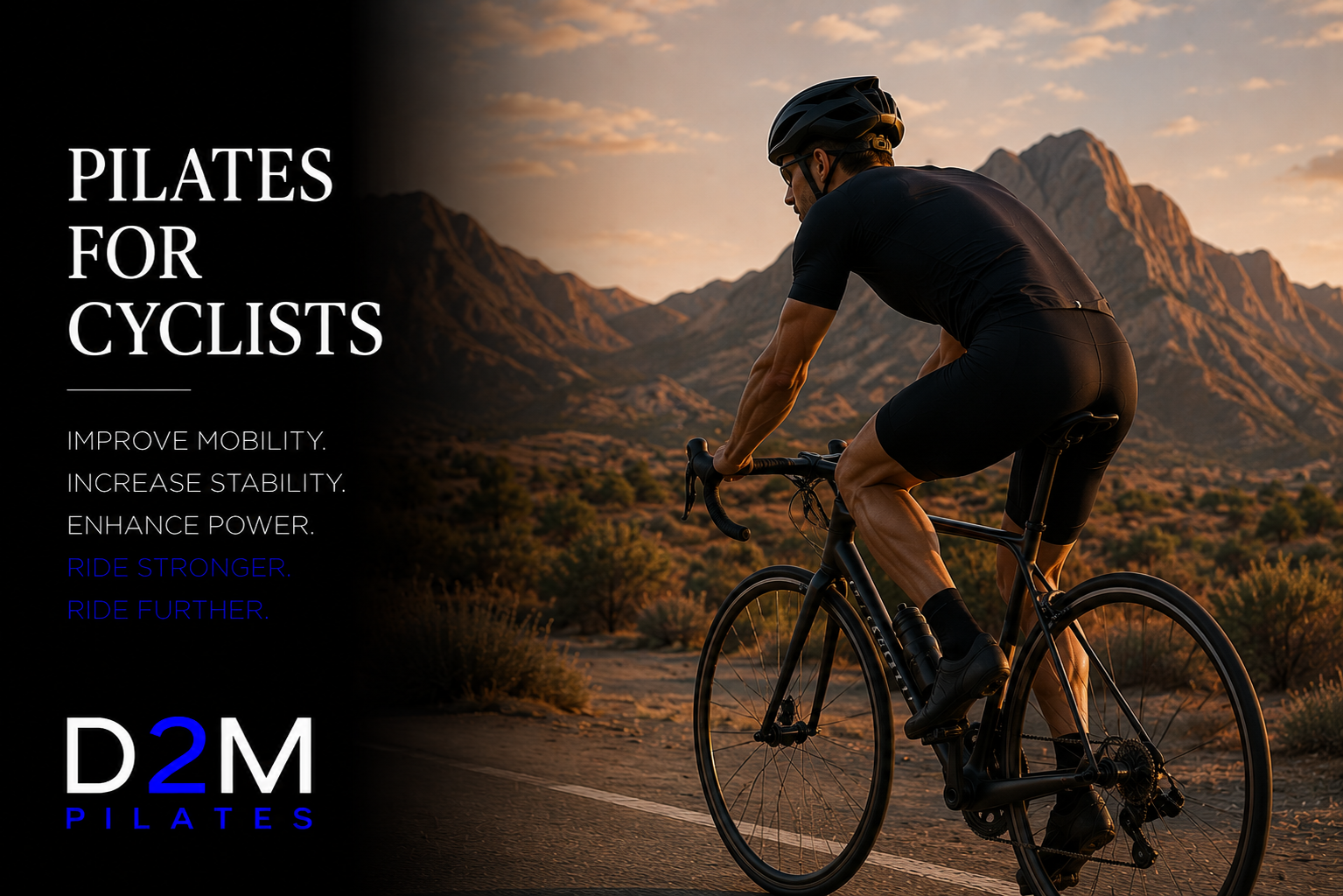
Cycling builds fitness while creating imbalance.
Cycling is one of the most effective cardiovascular training modalities available. It is also one of the most posturally demanding — placing the body in sustained hip flexion, thoracic kyphosis, cervical extension, and shoulder protraction for hours at a time, repeatedly shortening the anterior chain while leaving the posterior chain progressively underworked.
The result is a predictable pattern of cycling-related dysfunction: shortened hip flexors that restrict running mechanics, tight thoracic spine that loads the cervical spine and shoulders, weak glutes that shift power production to the quads, and knee tracking issues that develop into patellofemoral pain or IT band syndrome.
Pilates directly reverses these cycling-induced patterns — releasing the hip flexors, extending the thoracic spine, activating the posterior chain, and building the lateral stability that protects the knee under cycling load.
Cycling deficits Pilates corrects
Hip Flexor Shortening
Chronic hip flexion shortens the hip flexors, tilts the pelvis anteriorly, and restricts the hip extension needed for powerful pedaling and running off the bike.
Thoracic Kyphosis
Extended time in the cycling aero position stiffens the thoracic spine into kyphosis — loading the cervical spine, restricting shoulder movement, and reducing breathing capacity.
Scapular Stability
Supporting body weight through the arms in cycling loads the scapular stabilizers repetitively without the opposing movement that would maintain balance.
Knee Tracking
Patellofemoral pain and IT band syndrome in cyclists are typically caused by hip abductor weakness and poor lateral stability — directly addressable through Pilates.
Posterior Chain Activation
Cycling-dominant training creates quad dominance and glute inhibition. Pilates posterior chain activation improves power transfer and reduces anterior knee loading.
Off-Bike Recovery
Pilates breathing mechanics, parasympathetic activation, and fascial release dramatically improve the quality of recovery between hard training sessions.
What cyclist Pilates delivers
More power output
When glutes are activated and hip extension is full, power production in the pedal stroke increases — more watts at the same perceived effort.
Pain-free riding
The cervical, thoracic, and knee pain that commonly develops in cyclists is largely preventable through the movement corrections Pilates provides.
Better run performance off the bike
Hip flexor mobility gained through Pilates directly unlocks running stride length — one of the highest-return gains available to triathletes and duathletes.
Improved body position
Thoracic extension and scapular stability allow a more aerodynamic, sustainable body position on the bike with less fatigue and discomfort over long rides.
Reduced overuse injury risk
IT band syndrome, patellofemoral pain, and cyclist's back are largely preventable with the lateral stability and movement corrections Pilates provides.
Faster recovery
Pilates session recovery benefits allow higher training volume absorption — getting more from each block without the accumulated fatigue that limits performance.
Cycling Pilates FAQ
Can Pilates help with cycling back pain?
Yes. Cycling back pain is typically caused by thoracic stiffness forcing lumbar compensation and hip flexor tightness creating anterior pelvic tilt. Both are directly addressable through Pilates.
Will Pilates help my knee pain from cycling?
Most cycling knee pain is caused by hip abductor weakness and poor lateral stability — the exact deficits Pilates targets. Most cyclists see significant improvement within a few weeks of consistent targeted work.
Can I do Pilates in the off-season to build for cycling?
Yes — and the off-season is the ideal time for the foundational work that translates to performance gains in season. D2M programs can be fully periodized around your training calendar.
How often should cyclists do Pilates?
Most cyclists benefit from 1–2 sessions per week. During heavy training blocks, one maintenance session per week supports recovery and maintains the gains built in the foundation phase.
Does Pilates help triathletes as well as pure cyclists?
Yes — and for triathletes the gains are compounded. Releasing cycling-shortened hip flexors through Pilates directly improves running mechanics off the bike, making it one of the highest-return investments a triathlete can make.
Can Pilates help with saddle discomfort or hip impingement from cycling?
Yes. Hip flexor tightness and pelvic positioning on the bike contribute significantly to saddle discomfort and hip impingement. Pilates hip mobility and stabilization work often resolves these issues before a bike fit adjustment is even needed.
More power, less pain, more miles.
Book a cycling movement assessment at D2M and discover the hip mobility and posterior chain gains that are waiting in your pedal stroke.