Run further.
Run faster.
Run for longer.
Pilates programming built specifically for runners — improving gait mechanics, hip stability, glute activation, and injury resilience for road runners, trail runners, and triathletes.
Book a Session →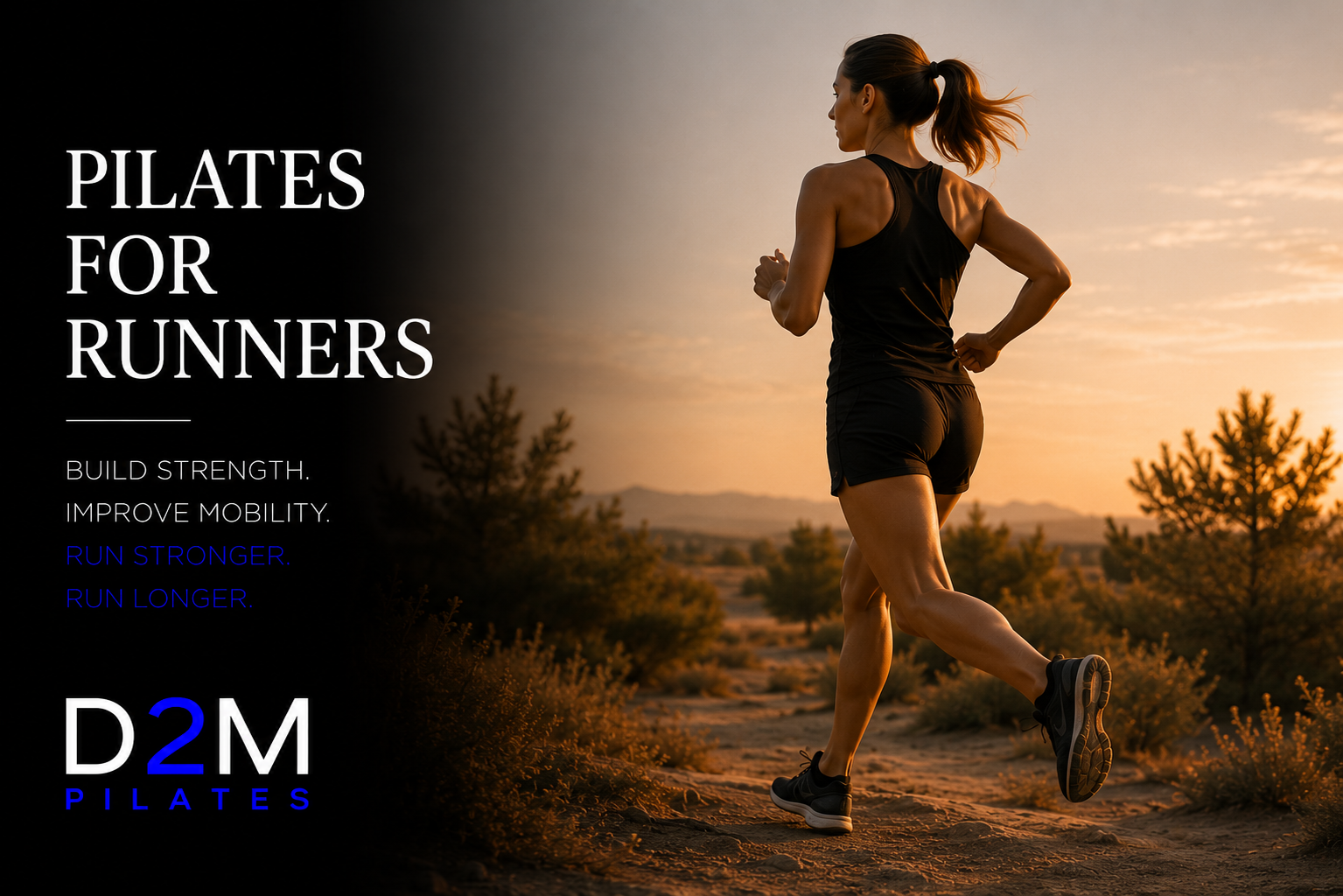
Running is repetitive. Every flaw gets amplified.
Running is a single-leg sport performed thousands of times per session. Every biomechanical inefficiency — hip drop, knee valgus, forward lean, overstriding, weak glute activation — is repeated with every stride, accumulating tissue stress that eventually produces injury.
The most common running injuries — IT band syndrome, patellofemoral pain, Achilles tendinopathy, stress fractures, and hip flexor strains — are almost all the result of movement pattern dysfunction, not bad luck. The hip abductors are weak. The glutes are inhibited. The lumbo-pelvic complex is unstable. Pilates addresses every one of these deficits directly.
At D2M, runner programming begins with a gait and movement assessment that identifies your specific pattern deficits. Your program is then built to address exactly those deficits — improving your mechanics, protecting your body, and building the structural resilience that lets you run the miles you want.
The running deficits Pilates corrects
Hip Abductor Weakness
The single most common contributor to running injuries. Weak hip abductors cause Trendelenburg gait, IT band loading, and knee valgus on every landing. Pilates targets these systematically.
Glute Inhibition
Inhibited glutes shift propulsion load to the hip flexors and quads, increasing anterior chain fatigue and injury risk. Pilates reactivates the glute complex with precision.
Lumbo-Pelvic Instability
Pelvic rotation and drop during single-leg stance wastes energy and loads the lumbar spine. Pilates builds the deep stabilizer co-contraction that holds the pelvis level at every stride.
Ankle and Foot Mechanics
Push-off power, tibialis posterior function, and calf-Achilles loading are all addressable through Pilates — building the foot and ankle resilience running demands.
Thoracic Stiffness
A stiff thoracic spine limits arm swing rotation, forces compensatory lumbar movement, and reduces running efficiency. Pilates thoracic mobility work is transformative for runners.
Eccentric Deceleration
Downhill running and landing mechanics require eccentric quad and glute strength. Pilates builds eccentric control with the precision needed for safe, powerful deceleration.
What runner Pilates delivers
Reduced injury risk
Addressing the biomechanical deficits that cause running injuries before they become injuries is the most effective injury prevention strategy available.
Improved running economy
When the hip stabilizers, glutes, and core function optimally, less energy is wasted in compensatory movement — improving running economy and performance at every distance.
Single-leg stability
Running is fundamentally a single-leg activity. Pilates builds the single-leg strength and stability that running demands in a controlled, progressive environment.
Better recovery
The fascial release, breathing mechanics, and parasympathetic activation of Pilates sessions supports recovery between training sessions — letting you absorb training more effectively.
Longevity in the sport
Runners who address their movement deficits through clinical Pilates extend their competitive and recreational running careers significantly.
Performance integration
D2M sessions are periodized around your training schedule and race calendar — building during base periods, maintaining during peak training, and supporting recovery after races.
Running Pilates FAQ
Will Pilates make me a faster runner?
Pilates improves running economy by eliminating compensatory movement patterns and building the stabilizers that power efficient running. Most runners experience measurable performance improvements alongside injury risk reduction.
How often should runners do Pilates?
Most runners benefit from 1–2 Pilates sessions per week alongside their training. During high-volume training blocks, one maintenance session per week is effective. Sessions are periodized around your training calendar and race schedule.
Can Pilates help IT band syndrome?
Yes. IT band syndrome is almost always caused by hip abductor weakness and poor lumbo-pelvic control — both directly addressed by Pilates programming. Most clients see significant improvement within a few weeks of consistent targeted work.
Is Pilates better than strength training for runners?
Pilates addresses the deep stabilizer system, movement pattern quality, and kinetic chain integration that conventional strength training often misses. The two are complementary — Pilates builds the foundation that makes strength training more effective and injury-resistant.
Can Pilates help plantar fasciitis?
Yes. Plantar fasciitis in runners is often driven by calf-Achilles loading patterns, tibialis posterior weakness, and altered foot mechanics. Pilates addresses all of these contributors — reducing the overload that causes and perpetuates plantar fascia irritation.
When should I start Pilates — before I get injured or after?
Before, without question. Post-injury Pilates is highly effective, but the greatest value is preventive — identifying and correcting the movement pattern deficits that cause running injuries before they produce weeks of lost training.
Build the body your running demands.
Book a running movement assessment at D2M and discover exactly what your movement pattern is costing you — and how to fix it.