More power.
Sharper movement.
Fewer injuries.
Clinical Pilates programming built for soccer — hip stability, deceleration control, kicking mechanics, and the ankle and knee resilience that competitive soccer demands across a full season and beyond.
Book a Session →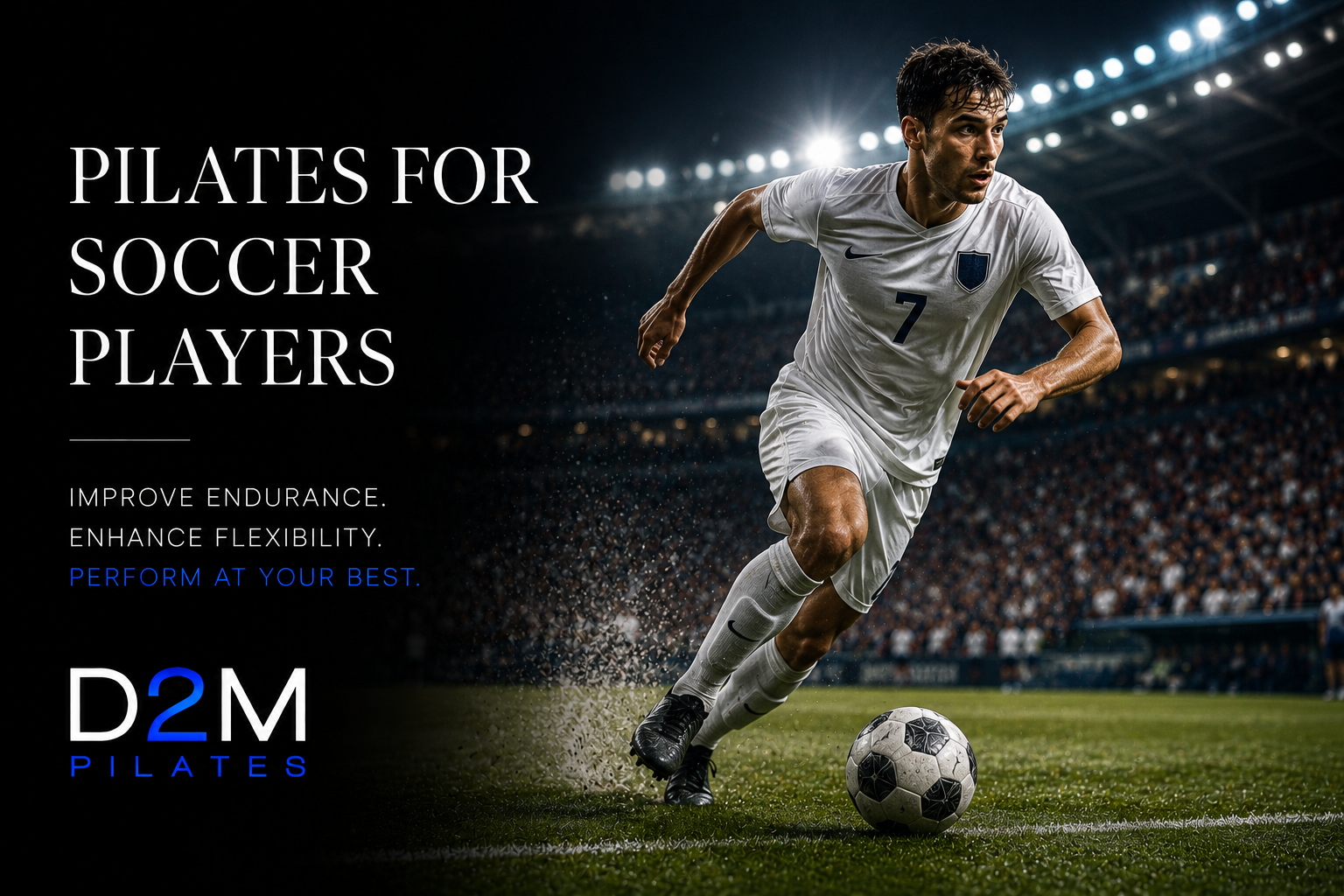
Soccer runs 90 minutes on one leg thousands of times a season.
Soccer is a running sport that requires explosive acceleration, repeated deceleration, multidirectional cutting, and powerful single-leg kicking mechanics — performed across 90-minute matches, multiple times per week, for seasons that run most of the year. The cumulative loading this places on the hip, knee, and ankle complex is extraordinary.
The injuries that define soccer — ACL tears, hamstring strains, groin pulls, ankle sprains, and patellar tendinopathy — follow predictable patterns of hip stability deficit, deceleration weakness, and movement compensation that accumulate under the volume of the sport. Pilates addresses every one of these patterns at their source.
At D2M, soccer programming is built around the specific movement demands of the sport and the individual player's position — the single-leg cutting mechanics of a winger, the heading and aerial duel demands of a center back, the explosive change-of-direction requirements of a central midfielder, and the goalkeeper's explosive lateral movement and diving mechanics.
Soccer movement deficits Pilates corrects
Deceleration and ACL Protection
The majority of soccer ACL injuries occur during deceleration and direction change. Pilates builds the eccentric hip and quad control that produces safe deceleration mechanics and dramatically reduces ACL injury risk.
Kicking Power and Mechanics
Kicking power comes from hip flexor drive, glute activation, and core rotational stability — not just quad strength. Pilates builds the kinetic chain mechanics that translate to more powerful, precise kicking.
Hip Stability and Groin Resilience
Hip abductor weakness and adductor loading deficits are the primary drivers of groin strain and sports hernia in soccer. Pilates addresses both with the progressive loading that soccer demands.
Hamstring Resilience
Hamstring strains in soccer peak during high-speed running. Pilates eccentric posterior chain loading builds the hamstring resilience to absorb sprinting demands at match intensity.
Ankle Stability
Ankle sprains are among the most common soccer injuries and have high recurrence rates. Pilates single-leg proprioceptive training and peroneal strengthening rebuilds the ankle stability that prevents them.
Structural Endurance
Maintaining optimal movement mechanics across 90 minutes requires structural endurance — the ability to keep hip stabilizers, core, and movement patterns functioning under fatigue. Pilates builds this directly.
What soccer Pilates delivers
Reduced ACL and hamstring injury risk
Addressing the deceleration mechanics and posterior chain strength deficits that cause soccer's two most common serious injuries is the most impactful thing any soccer player can do for their career.
More powerful kicking
Optimizing the hip flexor drive, glute activation, and core rotation that generate kicking power produces measurable shot velocity and distance improvements.
Sharper cutting mechanics
Hip stability and lateral chain strength improvements translate directly to sharper, faster cutting — the defining quality of elite attacking and defensive play.
Better second-half performance
When deep stabilizers and movement patterns hold up under 90-minute fatigue, second-half performance drops less. Structural endurance built through Pilates directly protects late-game quality.
Ankle injury prevention
Pilates proprioceptive training is among the most evidence-supported approaches to ankle sprain prevention — reducing first sprains and dramatically lowering recurrence rates.
Longevity in the game
The players who compete at the highest level into their mid-30s are those who invested in movement quality and structural resilience — the exact foundation Pilates builds.
Soccer Pilates FAQ
Can Pilates help prevent ACL injuries in soccer?
Yes — this is one of the most evidence-supported applications of Pilates in sport. ACL injury risk in soccer is primarily determined by deceleration mechanics and hip stability, both of which Pilates addresses directly. The research on neuromuscular training programs for ACL prevention in soccer is robust and consistently positive.
Will Pilates help my kicking power?
Yes. Kicking power comes from the kinetic chain — hip flexor drive, glute activation, core rotation, and the transfer of force from the supporting leg through the kicking leg. Pilates builds every link in this chain more specifically than conventional leg strength training.
Is Pilates appropriate during a competitive season?
Yes. In-season sessions are periodized around match and training schedules — typically one session per week focused on maintenance, recovery support, and injury prevention rather than high-load conditioning.
Can Pilates help with recurrent groin issues?
Yes. Recurrent groin strains in soccer are almost always caused by progressive loading deficits and hip stability issues that were never fully addressed after the first injury. Pilates progressive adductor and hip stability programming is highly effective for breaking this cycle.
The movement quality the beautiful game demands.
Book a soccer movement assessment at D2M and discover the deceleration control, kicking power, and injury resilience gains waiting in your mechanics.