More rotation.
More velocity.
Arm stays healthy.
Clinical Pilates programming built for baseball — rotational power, hip-shoulder separation, thoracic mobility, and the shoulder and elbow resilience that pitchers, catchers, and position players need across the longest season in professional sport.
Book a Session →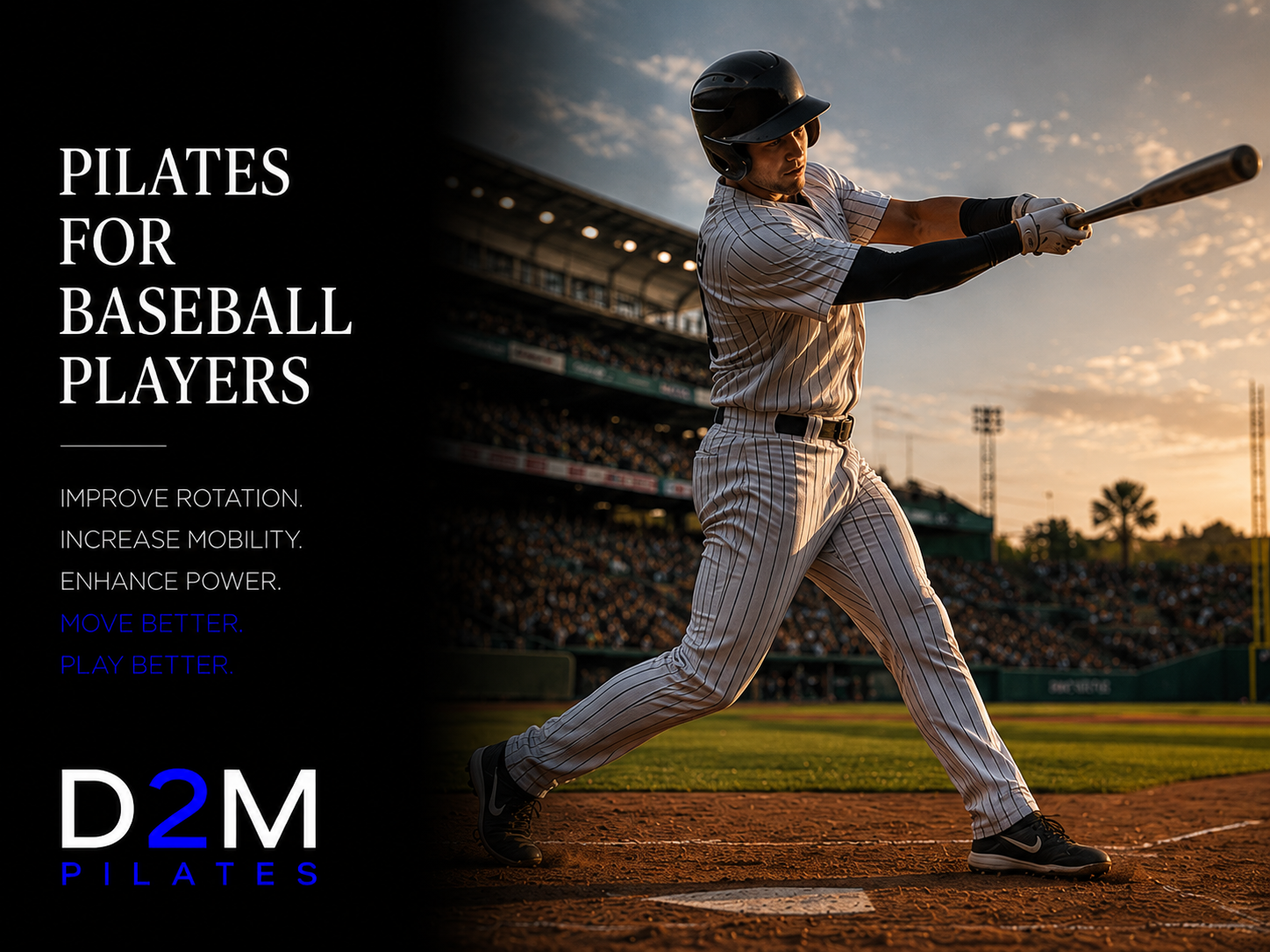
Baseball is the most rotationally demanding sport for the spine and shoulder.
The baseball swing and pitching delivery are among the most mechanically complex and physically demanding movements in professional sport. Both require maximum rotational velocity generated from the ground up — through the legs, through the hips, through a precisely sequenced kinetic chain, and delivered through the shoulder and arm with enough deceleration control to protect the structures that generate the force.
The shoulder and elbow injuries that define baseball — rotator cuff tears, UCL injuries, labral tears, and thoracic outlet syndrome — are the endpoint of accumulated kinetic chain dysfunction. When the hips lack mobility, when the thoracic spine is stiff, when the deep stabilizers are not sequencing correctly, the distal shoulder and elbow compensate and absorb force they were not designed to handle.
At D2M, baseball programming addresses the complete rotational kinetic chain — hip mobility and drive, thoracic rotation, scapular timing, and the proximal stability that protects the arm. Programs are built for the specific demands of each position and periodized around spring training, the regular season, and the off-season development window.
Baseball movement deficits Pilates corrects
Hip-Shoulder Separation
The power differential between hip rotation and shoulder rotation — hip-shoulder separation — is the primary determinant of bat speed and pitch velocity. Pilates builds the mobility and stability that maximize this separation.
Thoracic Rotation Mobility
Restricted thoracic rotation forces the lumbar spine and shoulder to compensate — the primary mechanism driving baseball's most common injuries. Pilates thoracic mobilization is transformative for rotational athletes.
Lead Hip Internal Rotation
Lead hip internal rotation restriction is one of the most common biomechanical deficits in baseball players — limiting front-side blocking, reducing power output, and loading the lumbar spine and arm.
Scapular Stability and Timing
Precise scapular movement and stabilization is critical for overhead throwing mechanics. Pilates builds the rotator cuff coordination and scapular timing that protects the arm under velocity.
Arm Deceleration Mechanics
Arm injuries in pitching most often occur in the deceleration phase — when the posterior shoulder and rotator cuff must absorb the energy of the throw. Pilates posterior chain and rotator cuff work addresses this directly.
Rotational Asymmetry Correction
Years of swinging and throwing in one direction create significant bilateral asymmetries. Pilates identifies and corrects these — improving mechanical efficiency and reducing injury risk at every level.
What baseball Pilates delivers
More bat speed and pitch velocity
Maximizing hip-shoulder separation, thoracic rotation, and kinetic chain sequencing through Pilates produces measurable improvements in rotational velocity — the foundation of hitting and pitching performance.
Shoulder and elbow protection
Addressing the hip mobility, thoracic stiffness, and scapular timing deficits that force the arm to compensate is the most effective long-term arm health strategy available.
Season-long arm freshness
The fascial release, posterior chain recovery work, and parasympathetic activation of Pilates sessions supports the arm recovery that 162 games demands — maintaining arm health from April through October.
Better mechanical consistency
When the kinetic chain is moving optimally and asymmetries are corrected, swing and delivery mechanics become more repeatable — improving consistency across a full season.
Faster return from soft tissue injury
When Pilates post-rehabilitation protocols are applied to shoulder, oblique, and hip flexor injuries, return-to-play timelines shorten and recurrence rates drop significantly.
Career longevity
The players who compete at the highest level for 15-plus seasons are those who invested in kinetic chain health and movement quality — the exact foundation Pilates builds.
Baseball Pilates FAQ
Can Pilates help increase pitching velocity?
Yes. Pitch velocity is determined by kinetic chain efficiency — the sequential transfer of ground force through the legs, hips, trunk, and shoulder to the ball. Pilates improves the hip mobility, thoracic rotation, and proximal stability that allow this chain to function at maximum efficiency.
Is Pilates appropriate for pitchers during the season?
Yes — with periodization. In-season pitcher programming focuses on thoracic mobility maintenance, scapular stabilization, posterior chain recovery, and the hip mobility work that protects the arm. High-load conditioning is reserved for the off-season.
Can Pilates help after UCL surgery (Tommy John)?
Yes. Post-Tommy John rehabilitation through Pilates addresses the kinetic chain deficits that contributed to the UCL injury — ensuring that return to throwing is built on a mechanically sound foundation rather than simply waiting for the graft to heal.
Is Pilates useful for position players, not just pitchers?
Absolutely. Every position in baseball involves rotational demands — from the catcher's quick throws to second base to the outfielder's long throws to the plate. Pilates benefits every player whose performance depends on rotational efficiency and arm health.
More rotation. More velocity. Less arm injury.
Book a baseball movement assessment at D2M and discover the hip-shoulder separation, thoracic mobility, and arm resilience gains waiting in your mechanics.