More power.
Faster recovery.
Sharper mechanics.
Pilates programming built for tennis — shoulder complex stability, rotational power, deceleration control, and the lateral agility that determines performance across every surface.
Book a Session →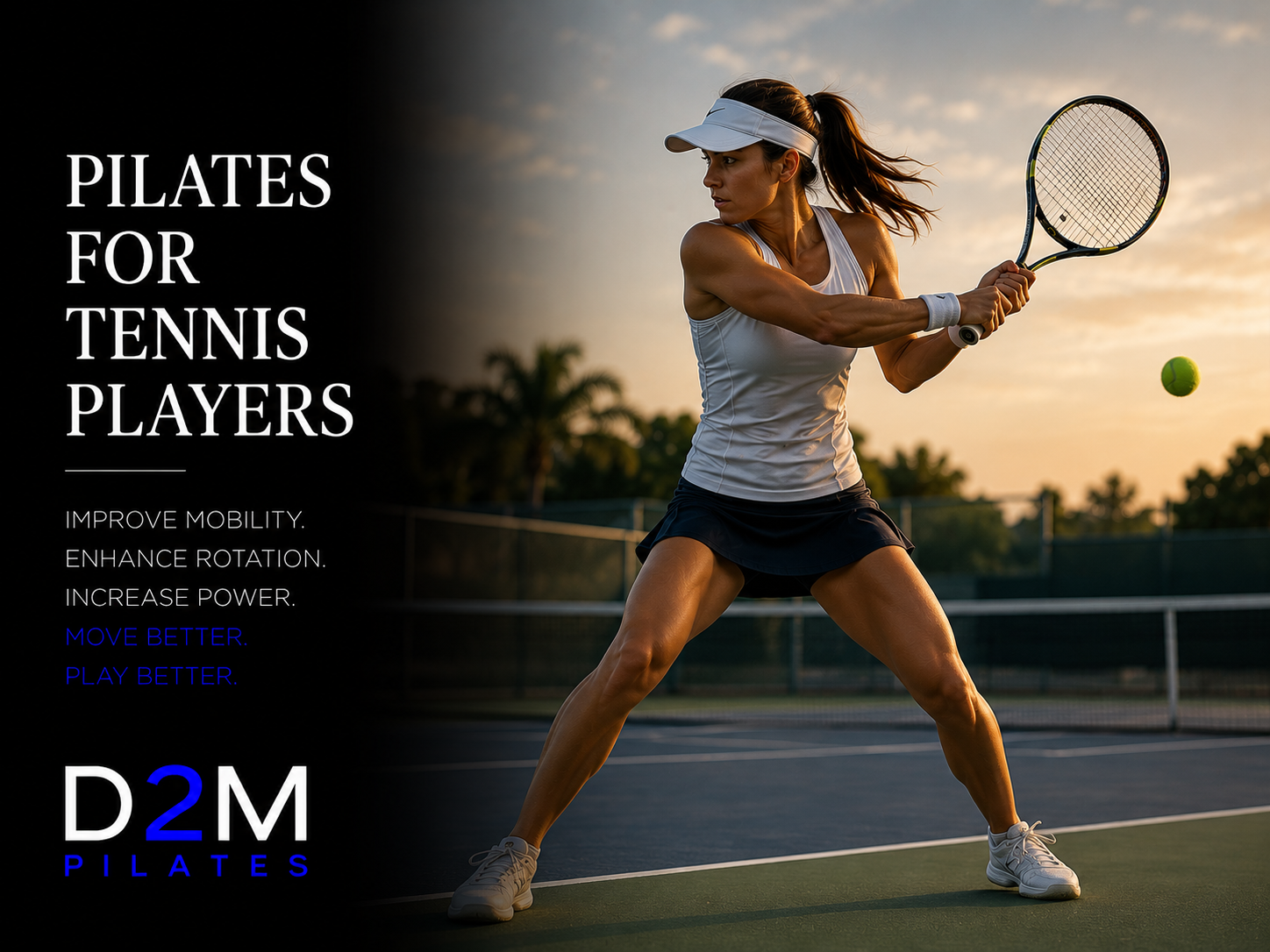
Tennis is an asymmetric power sport
that demands bilateral balance.
Tennis is one of the most physically demanding racket sports — requiring explosive rotational power, precise overhead mechanics, repeated lateral deceleration, and the endurance to maintain all of these across long matches. It is also profoundly asymmetric, developing dominant-side strength and mobility at the expense of the non-dominant side.
The tennis injuries that end seasons — rotator cuff tears, lateral epicondylitis, oblique strains, hip labral tears, and stress fractures — are almost always the result of accumulated asymmetry and movement dysfunction rather than single traumatic events.
At D2M, tennis programming is built around the movement demands of your game — serve mechanics, groundstroke rotation, lateral deceleration patterns, and the shoulder complex loading tennis places on the body match after match and season after season.
Tennis deficits Pilates corrects
Serve Mechanics & Shoulder Health
The serve is the most shoulder-demanding motion in tennis. Pilates rotator cuff coordination, scapular stabilization, and overhead loading mechanics protect the shoulder while building serve power.
Groundstroke Rotation
Thoracic rotation, hip dissociation, and core-driven power transfer determine groundstroke pace and consistency. Pilates builds all three with the specificity tennis demands.
Deceleration Control
Court tennis requires repeated explosive deceleration — the eccentric loading that produces most tennis injuries. Pilates builds the deceleration control that keeps knees, hips, and ankles safe.
Dominant-Side Asymmetry
Years of playing tennis create significant strength and mobility asymmetries. Pilates identifies and corrects these — improving consistency and dramatically reducing injury risk.
Lateral Movement Efficiency
Hip abductor strength, lateral stability, and dynamic balance determine court coverage speed. Pilates targets these directly for every level of player.
Elbow and Wrist Mechanics
Lateral epicondylitis and wrist injuries in tennis are often driven by shoulder mechanics and grip pattern deficits. Pilates addresses the kinetic chain contributors.
What tennis Pilates delivers
More serve power
When the kinetic chain from ground to racket is sequencing optimally, serve velocity increases without additional effort — or shoulder risk.
Injury-free seasons
The shoulder, elbow, and lower extremity injuries that interrupt tennis seasons are largely preventable through the asymmetry correction and movement quality work Pilates provides.
Better court movement
Hip stability and lateral strength improvements translate directly to faster, more efficient court coverage with less energy expenditure.
Longer playing career
Tennis is a lifelong sport. The players who continue competing well into their 60s and 70s are those who address their movement patterns before injury forces them to stop.
Improved recovery between matches
Pilates breathing and fascial release significantly reduce the accumulated tension and recovery time between matches during tournaments and intense training periods.
Mental precision
The body awareness and movement precision that Pilates develops transfers to the court — improving the proprioceptive accuracy that determines stroke consistency.
Tennis Pilates FAQ
Can Pilates help tennis elbow?
Tennis elbow is often driven by shoulder mechanics and grip pattern issues rather than elbow pathology alone. Pilates addresses the kinetic chain contributors — scapular stability, rotator cuff coordination, and thoracic rotation — that reduce forearm overloading.
Will Pilates help my serve?
Yes. Serve power comes from kinetic chain sequencing — ground force through the legs, rotating through the trunk, and transferring through the shoulder to the racket. Pilates builds every link in this chain more effectively than isolated strength training.
Is Pilates appropriate for junior tennis players?
Yes. Junior players benefit enormously from the body awareness, bilateral balance work, and movement pattern quality that Pilates develops — building a foundation that supports their development through junior, college, and professional levels.
How often should tennis players do Pilates?
Most players benefit from 1–2 sessions per week during the playing season. Pre-season is an ideal time for more intensive foundation work. Sessions are periodized around your match and tournament schedule.
Can Pilates help with a rotator cuff injury from tennis?
Yes. D2M's Post-Rehabilitation Specialist credential means we can manage rotator cuff injuries with clinical precision — whether that is a partial tear, impingement, or post-surgical recovery. Programming is coordinated with your orthopedic specialist throughout.
Is Pilates useful for pickleball players too?
Yes — and pickleball places many of the same shoulder, lateral movement, and deceleration demands as tennis. D2M has a dedicated program for pickleball players if that is your primary game.
The court advantage starts off the court.
Book a tennis movement assessment at D2M and discover the serve power and injury resilience gains waiting in your mechanics.