Movement is
the medicine.
Precision is the key.
Clinical Pilates programming for stroke recovery, multiple sclerosis, Parkinson's disease, vestibular disorders, and neurological balance impairment — designed to challenge and rebuild the nervous system safely.
Book a Session →
The nervous system responds to movement challenge.
Neurological conditions affect movement through multiple pathways — weakness, spasticity, tremor, coordination deficits, balance impairment, and fatigue. The common thread is that the nervous system has lost its ability to send or receive the movement signals needed for normal function.
Pilates is uniquely suited to neurological rehabilitation because it challenges proprioception, coordination, motor control, and balance simultaneously — in a controlled, supported environment where difficulty can be precisely calibrated.
At D2M, neurological clients receive programming specifically designed around their condition, current capacity, and goals. Sessions are structured to be appropriately challenging — enough to drive neuroplastic adaptation — while remaining safe and confidence-building throughout.
Neurological conditions D2M programs for
Stroke Recovery
Progressive movement programming to restore motor control, address hemiplegia or hemiparesis, rebuild bilateral coordination, and re-establish postural control.
Multiple Sclerosis
Fatigue-managed Pilates programming that improves core stability, balance, and functional movement while respecting the energy limitations and heat sensitivity common in MS.
Parkinson's Disease
Rhythm-based movement, rotational mobility, postural extension, and balance challenge programming that addresses the rigidity, bradykinesia, and postural instability of Parkinson's.
Vestibular Disorders
Controlled balance challenge and gaze stabilization programming for vestibular hypofunction, BPPV residuals, and chronic dizziness affecting movement confidence and fall risk.
Traumatic Brain Injury
Graduated cognitive-motor programming that rebuilds dual-task capacity, motor sequencing, and postural control following TBI at any stage of recovery.
Age-Related Balance Decline
Progressive proprioceptive and balance challenge programming for older adults experiencing balance impairment, fear of falling, and movement restriction.
What neurological Pilates delivers
Neuroplasticity through movement
Repetitive, varied, proprioceptively rich movement input drives the neuroplastic changes underlying recovery — in a controlled, progressive environment.
Safe balance challenge
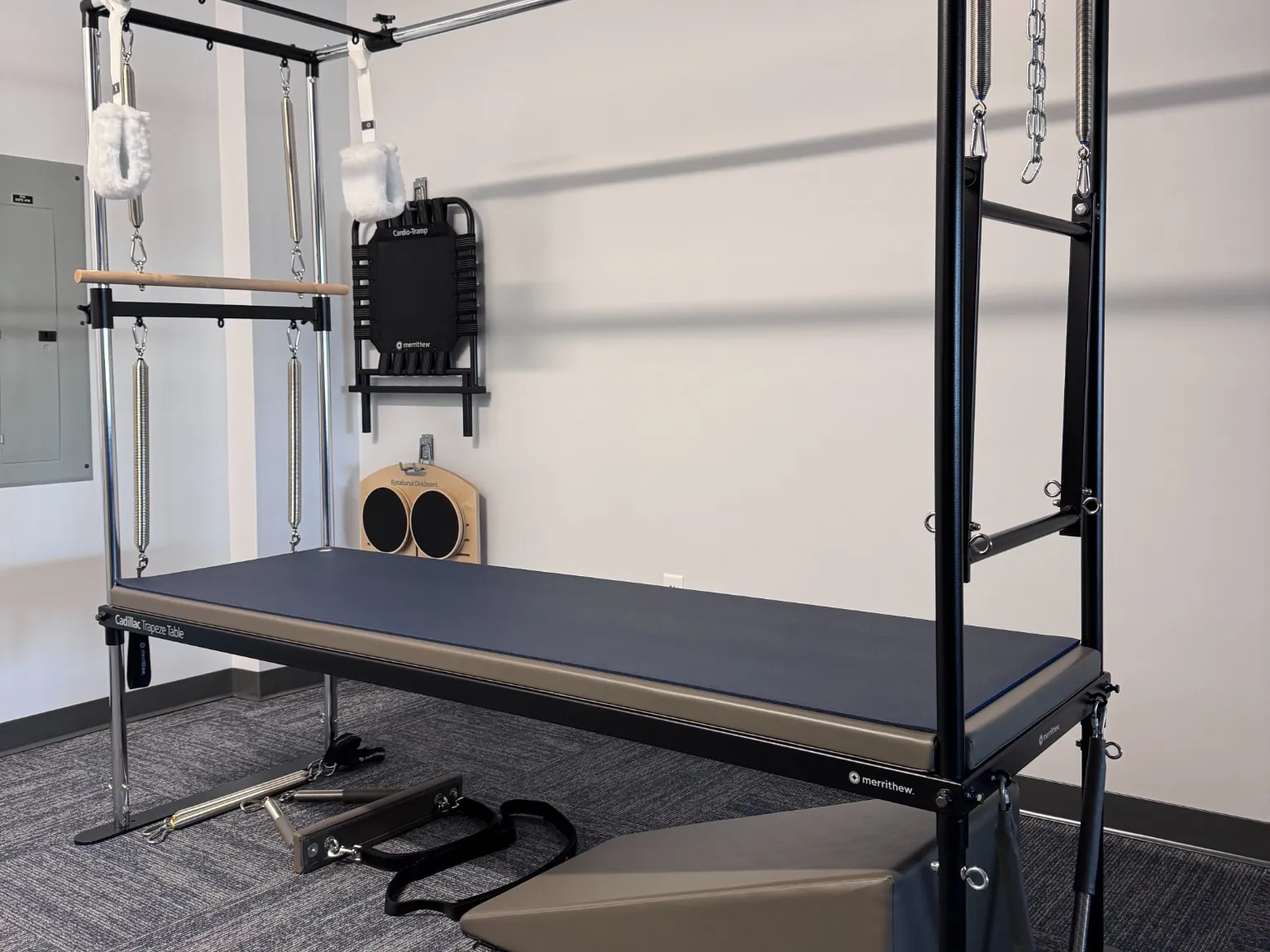
The apparatus provides support that allows clients to practice balance-challenging positions safely — developing reactive postural control without fall risk.
Bilateral coordination
Many neurological conditions create movement asymmetries. Pilates systematically trains coordinated bilateral movement essential for walking and functional independence.
Fatigue management
Neurological fatigue is different from muscular fatigue. D2M programs deliver meaningful challenge while respecting the energy limitations neurological conditions impose.
Movement confidence
Fear of movement and fear of falling are significant barriers to neurological recovery. Progressive Pilates builds movement confidence in a safe, supported environment.
Functional independence
Every exercise at D2M is selected for its transfer to real functional demands — getting up from the floor, carrying groceries, walking on uneven surfaces.
Neurological Pilates FAQ
Can Pilates help after a stroke?
Yes. Pilates-based movement therapy supports stroke recovery by challenging motor control, bilateral coordination, and postural stability in a progressive, safe environment. Timing and intensity are calibrated to each client's recovery stage.
Is Pilates safe for Parkinson's disease?
Yes. Rhythm, rotation, postural extension, and balance work directly address the core motor manifestations of Parkinson's — and the apparatus provides the safety needed to challenge balance appropriately.
Can someone with MS do Pilates?
Yes. Pilates is well-suited to MS because difficulty can be precisely managed, sessions can be kept cool, and fatigue can be monitored and respected.
How is neurological Pilates different from regular Pilates?
Neurological Pilates is specifically calibrated to the movement capacity, fatigue levels, and neuroplasticity principles of each condition. Session structure, exercise selection, complexity progression, and rest management are all adapted — it is fundamentally different from a standard Pilates program.
Can Pilates help with balance after a vestibular disorder?
Yes. Controlled balance challenge, gaze stabilization, and proprioceptive training through Pilates are evidence-supported approaches to vestibular compensation and balance recovery.
Your nervous system is more adaptable than you know.
Book a session at D2M and start with a full movement assessment. We will build a program calibrated to your current neurological capacity and long-term goals.