Precision.
Control.
Performance longevity.
Pilates programming built for the demands of dance and performance — articulation precision, eccentric control, stability in extreme ranges, and the body intelligence that separates good performers from exceptional ones.
Book a Session →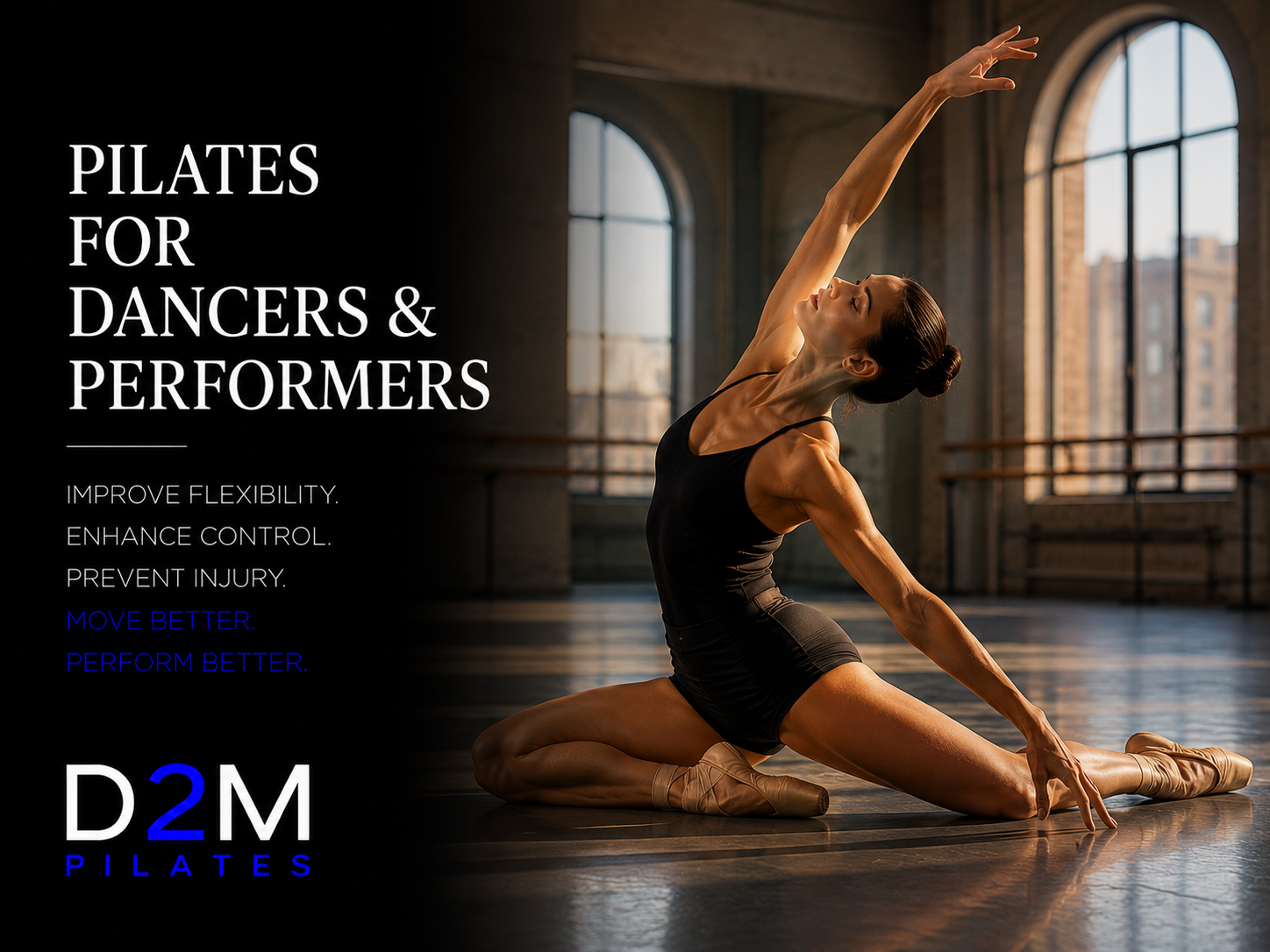
Dance demands more than flexibility.
It demands controlled range.
Dancers possess extraordinary flexibility — but flexibility without the neuromuscular control to move safely through extreme ranges is one of the leading causes of dance injury. The splits, extensions, and rotations that dance demands require not just range of motion but precise muscular control at every point within that range.
Pilates is the original dance conditioning system — Joseph Pilates developed the method in collaboration with the dance world, and it remains the most specific and effective tool available for building the deep stabilizer strength, movement precision, and body intelligence that elite performance demands.
At D2M, dancer and performer programming is built around the specific demands of each client's discipline — classical ballet, contemporary dance, musical theatre, gymnastics, or martial arts — with exercises selected to build the eccentric control, joint stability, and movement precision their art requires.
Performance deficits Pilates corrects
Controlled Range of Motion
Flexibility without control is a liability. Pilates builds the neuromuscular control that allows dancers to move safely and precisely through their full range of motion in every plane.
Eccentric Strength
Landing from jumps, lowering into splits, and decelerating from high-velocity movements require eccentric strength. Pilates builds this with the precision dance demands.
Hip External Rotation Control
True turnout comes from deep hip external rotators, not from forcing the knees out. Pilates develops the deep rotators while protecting the knee and ankle joints from compensation.
Deep Stabilizer Strength
The core strength required for sustained arabesque, balance sequences, and partner work is deep stabilizer strength — not superficial abdominal bracing. Pilates builds it specifically.
Foot and Ankle Articulation
Precise footwork — relevé, demi-pointe, full pointe — requires exceptional intrinsic foot strength and ankle control. Pilates addresses both with the detail dance demands.
Career Longevity
The performers who dance into their 40s and beyond are those who built the structural foundation that supports their art. Pilates is the most effective tool available for performance longevity.
What performer Pilates delivers
Precision and articulation
The body awareness and movement precision Pilates develops translates directly to performance quality — cleaner lines, more precise musicality, and the physical intelligence that separates good from exceptional.
Injury prevention
Most dance injuries are overuse injuries caused by movement dysfunction, hypermobility without control, and training volume that exceeds structural capacity. Pilates addresses all three.
Strength without bulk
Pilates builds the functional strength dance requires without the muscle bulk that can restrict range of motion and affect aesthetic line.
Breathing and stamina
Pilates breathing work builds the respiratory efficiency and nervous system regulation that sustains high-level performance throughout demanding rehearsal and performance schedules.
Rehabilitation when needed
Devi's Post-Rehabilitation Specialist credentials mean D2M can manage dancer injuries with clinical precision — returning performers to full capacity efficiently and safely.
Longer career
The investment in Pilates conditioning is an investment in the length of your performing career. The body you build now carries you through the performances ahead.
Dancer & performer Pilates FAQ
Is Pilates appropriate for classical ballet dancers?
Yes — Pilates was developed in close collaboration with the ballet world and remains the gold standard conditioning system for classical dancers. It builds the deep stabilizer strength and articulation precision that ballet demands at every level.
Can Pilates help with a dancer's injury?
Yes. D2M's Post-Rehabilitation Specialist credential means we can manage dance injuries with clinical precision — whether that is a stress fracture, ankle sprain, hip labral injury, or overuse condition. Programming is coordinated with your healthcare team throughout.
Is Pilates right for contemporary and non-classical dancers?
Absolutely. D2M programs are built around the specific demands of each discipline — contemporary, jazz, hip hop, musical theatre, and other movement arts are all programmed for individually.
How is Pilates different from regular dance conditioning classes?
Most dance conditioning focuses on flexibility, cardio, and general strength. D2M Pilates is individualized, clinically informed, and built specifically around each dancer's movement patterns, deficits, and performance goals.
Can Pilates help with hypermobility in dancers?
Yes — this is one of the most important applications of Pilates for dancers. Hypermobility without neuromuscular control is a significant injury risk factor. Pilates builds the deep stabilizer strength that provides stability across the full hypermobile range.
How often should dancers do Pilates?
Most dancers benefit from 1–2 sessions per week. During intensive rehearsal or performance periods, one maintenance session preserves the strength and body awareness gains. D2M sessions are periodized around your performance and training calendar.
The performance you want starts with the body you build.
Book a dancer movement assessment at D2M and discover the precision, control, and longevity gains available in your practice.